Nobody teaches you how to breathe during sex. It’s one of those things we assume the body handles automatically — and technically, yes, you won’t stop breathing. But there’s a significant difference between breathing because you have to and breathing in a way that actually changes the quality of the experience.
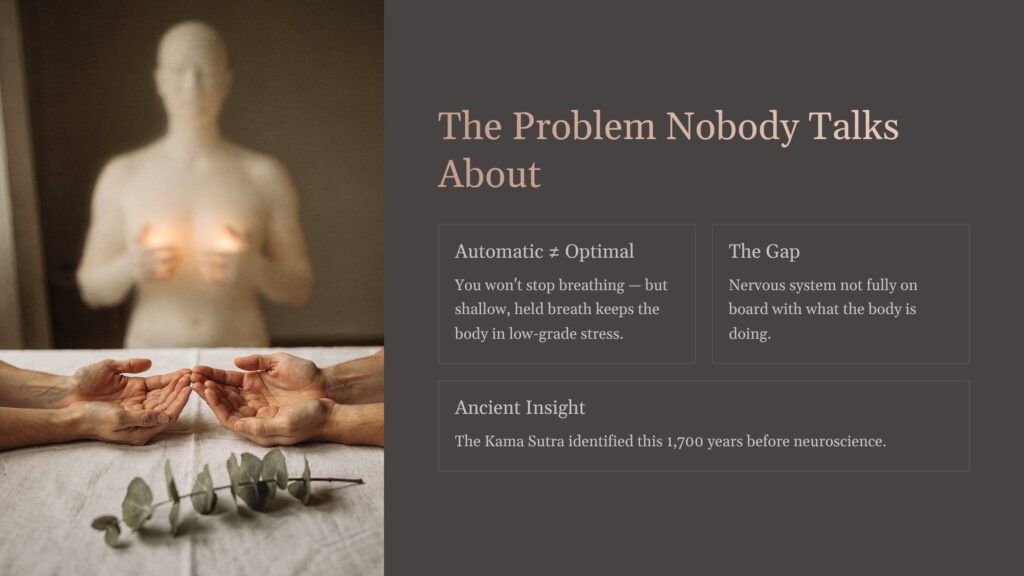
Here is something I observe consistently in my work with couples: when people are anxious, distracted, or performing — which describes a larger proportion of intimate encounters than most people admit — their breath becomes shallow, held in the chest, and irregular. And when breath is shallow and held, the body stays in a low-grade stress state regardless of what else is happening. Which means that for many couples, the nervous system is not fully on board with what the body is doing, and the experience reflects that gap.
The Kama Sutra identified this problem nearly 1,700 years before the first neuroscience laboratory opened. Its chapter on “Breathing as One” treats breath not as a background function but as the primary tool for arriving in the present moment, synchronising with a partner, and deepening both emotional and physical intimacy. It even identifies specific points during lovemaking — including the moments just before climax — where conscious breathwork produces effects that nothing else quite replicates.
This is not about yoga retreats or Tantric weekend workshops, though both draw on the same tradition. It is about something you can do tonight, lying next to your partner, that takes three minutes and will meaningfully shift the quality of your intimate connection.
Here is the complete guide.
Why Breath Is the Master Switch for Intimacy
Before getting into the techniques, it helps to understand why breath works — because once you understand the mechanism, the practices stop feeling like woo and start feeling like obvious tools you’ve been ignoring.
Your autonomic nervous system has two primary operating modes. You already know them by their popular names: fight-or-flight (sympathetic) and rest-and-digest (parasympathetic). What most people don’t know is that breathing is the only autonomic function you can control consciously — and that controlling it is the fastest way to shift which mode you’re in.
When you breathe in, your heart rate speeds up slightly. When you breathe out, it slows down. This is called respiratory sinus arrhythmia, and it’s the mechanism by which slow, deliberate exhalations activate the vagus nerve — the central channel of the parasympathetic nervous system. The vagus nerve is sometimes called the “social engagement system” because its activation is associated with precisely the states most important for intimacy: feelings of safety, openness, emotional warmth, and the capacity for genuine connection.
Here is the practical implication: if your breathing during intimacy is shallow, rapid, or held — as it often is when we’re anxious, self-conscious, or rushing — your nervous system interprets those signals as stress, regardless of what your brain knows about the situation. You can want to be present and connected while your body is physiologically running a mild stress response, and the two things will be in conflict throughout.
Slow, deliberate breath — particularly slow exhalations — deactivates that stress response. It tells the nervous system: this is safe, I am present, there is nothing to manage here. And from that state, the quality of everything else changes.
The Kama Sutra put it more poetically: “Taking deep breaths helps to relax your entire body and produces a feeling of calm and wellbeing that seems to rise up from your very core.”
Same mechanism. Different century. Same result.
The Three Breathing Practices the Kama Sutra Recommends
Practice 1: The Synchronisation Breath — Finding Each Other First
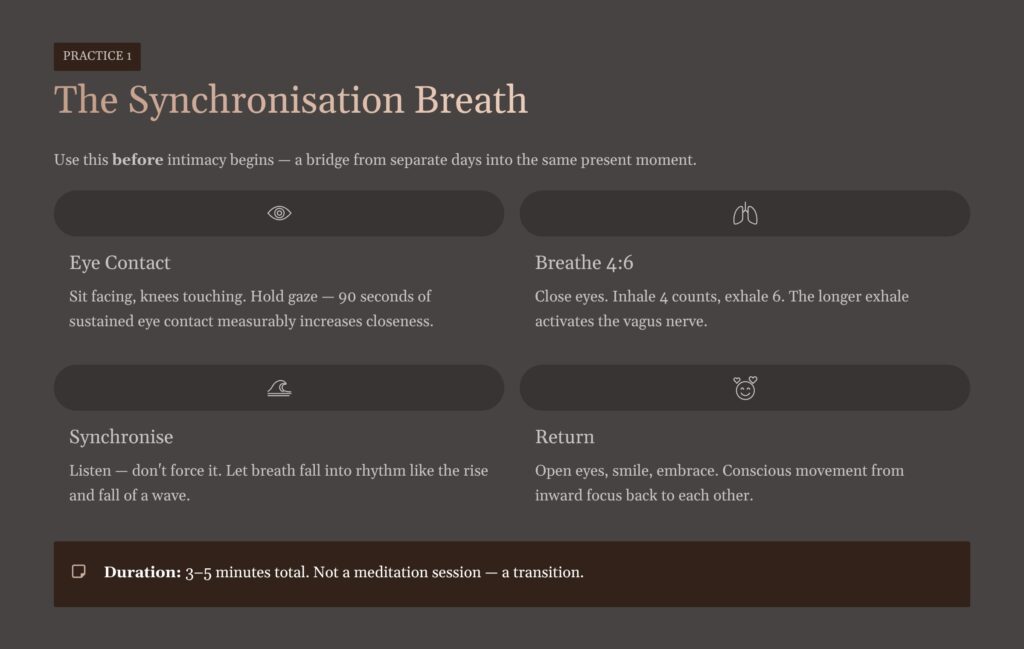
This is the foundational practice the text describes — the one to use before physical intimacy begins, as a way of arriving in the same room as each other rather than simply the same bed.
The full instruction from the text:
“Sit close together facing each other and stare deep into each other’s eyes. Feel as if you are looking into the very heart of your lover’s being. Then close your eyes, breathe deeply and slowly, and focus on each inhalation and exhalation of breath. Let your breath begin to move in time with your lover’s, imagining that it is like the rise and fall of a wave. As your breathing naturally falls into sync, you will feel at one with each other and enveloped by love and desire. When you feel ready, open your eyes and smile at your lover, acknowledging the warmth that you feel for each other, and embrace.”
That is, remarkably, a complete and usable technique. But let’s break it down into its component parts so you know exactly what you’re doing and why.
Step 1 — The position. Sit facing each other, close enough that your knees are touching or nearly touching. Cross-legged on the bed works well. The physical proximity matters — you are within breathing distance, and the point is to be able to feel each other’s breath as well as hear it.
Step 2 — Eye contact. The text instructs lovers to “stare deep into each other’s eyes” before closing them. This is not decorative. Research on mutual gaze between partners shows that sustained eye contact — even just 90 seconds — produces measurable increases in feelings of closeness and love, and activates the same neural circuits as early romantic attachment. The discomfort you may feel is exactly the point: eye contact at this proximity and duration is genuinely intimate, and sitting with that discomfort is itself a form of arriving.
Step 3 — Close your eyes and breathe. Once you’ve held the eye contact, close your eyes together. Begin breathing slowly and deliberately — inhaling for a count of four, exhaling for a count of six. The longer exhale is not arbitrary: it’s the exhalation that activates the vagus nerve and shifts the nervous system toward parasympathetic. If a 4:6 ratio is too long to start, try 3:5. The exhale simply needs to be longer than the inhale.
Step 4 — Synchronise. Don’t force synchronisation — listen for it. You’ll become aware of your partner’s breathing rhythm through the sound of it and the slight movement of their body. Let your breath begin to fall into time with theirs naturally. This may take two or three minutes. The moment it clicks — when you both breathe in and out together without effort — is genuinely distinctive. Most couples describe it as the first moment they feel properly together after a day apart.
Step 5 — Open your eyes. The text says: “open your eyes and smile at your lover, acknowledging the warmth that you feel for each other, and embrace.” This transition from the inward focus of synchronised breath back to each other’s faces is a specific, conscious movement from internal to relational. Don’t skip it.
Duration: Three to five minutes total is enough. This is not a meditation session. It is a transition — a bridge from your separate days into the same present moment.
Practice 2: The Centring Breath — Staying Present When Your Mind Wanders
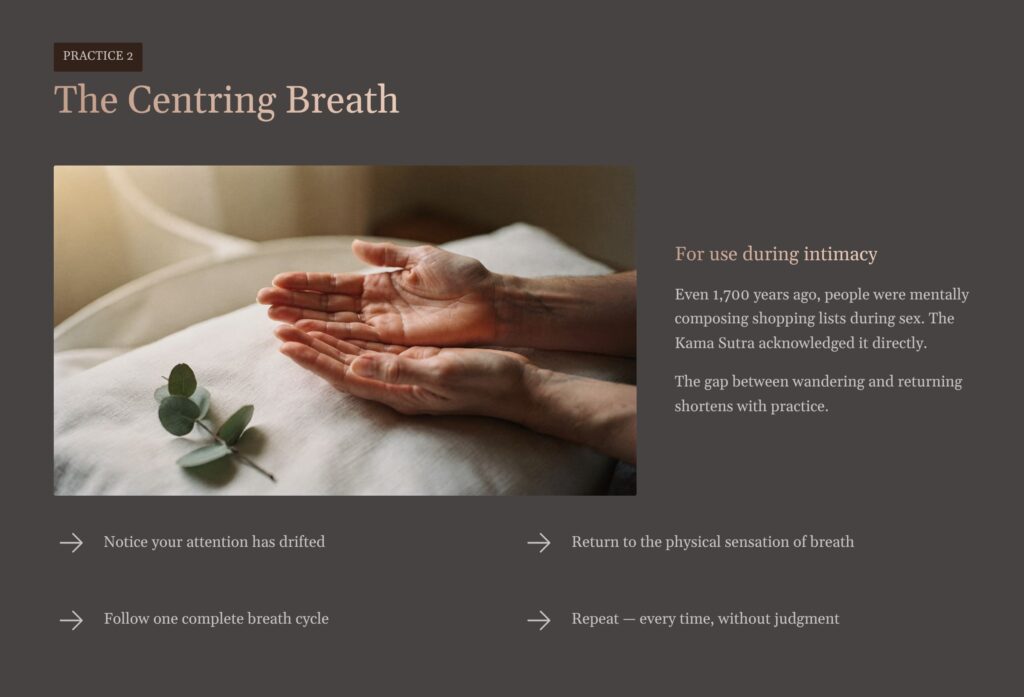
This is the practice for during intimacy — the one you reach for when you become aware that you have mentally left the room.
And you will leave the room. Everyone does. The Kama Sutra acknowledges this with a directness that is almost funny given how ancient the text is: focusing on breath helps you remain “fully conscious of the moment and not distracted by unnecessary thoughts, such as what you need to do at work the next day, or what you would like for supper.”
Even 1,700 years ago, people were mentally composing shopping lists during sex.
The centring breath is simple: whenever you notice your attention has drifted — into self-monitoring, performance anxiety, the day’s unfinished business, or any other destination that is not this room and this person — bring your attention back to your own breath. Feel the physical sensation of air moving through your nose or mouth. Notice the rise of your chest or belly. Follow one complete breath cycle.
That’s the whole practice. It sounds too simple to be useful, and it consistently surprises couples with how effective it is.
What makes it work is not the breath itself but the act of redirecting attention — which is a skill that improves with repetition, like a muscle. The first time you try this you will redirect your attention and be back in your head thirty seconds later. That is normal and expected. Redirect again. And again. Over weeks of practice, the gap between wandering and returning gets shorter, and the proportion of intimate time spent genuinely present rather than mentally elsewhere increases substantially.
The Kama Sutra pairs this with a specific body-awareness technique: rather than simply observing the breath, visualise the breath as energy moving through the body — from the base of the spine upward with each inhale, and releasing outward with each exhale. This visualisation is drawn from Tantric practice and is the precursor to the more elaborate energy circulation techniques used in advanced Tantra. For most couples, the simpler version — noticing the breath, feeling it move, returning when you wander — is both sufficient and immediately applicable.
Practice 3: The Climax Breath — The Technique Most Couples Have Never Tried
This is the one that tends to get people’s attention.
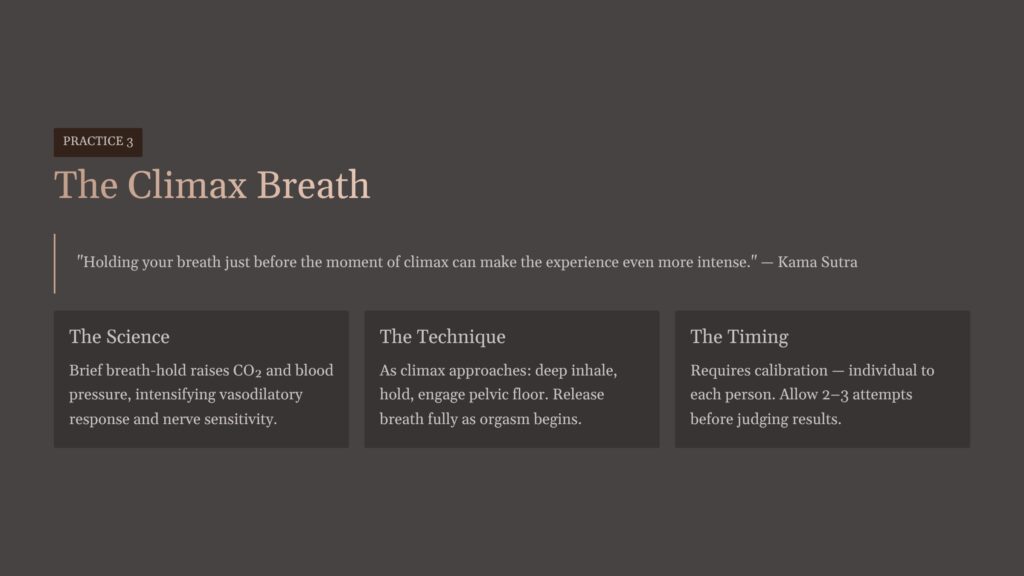
The Kama Sutra states it plainly: “Holding your breath just before the moment of climax can make the experience even more intense.”
This is not mysticism. It is a physiological technique with a straightforward mechanism, and it has a modern counterpart in sex research that confirms exactly what the ancient text was describing.
Here is how it works: breath-holding immediately before orgasm causes a brief, controlled increase in blood pressure and carbon dioxide in the bloodstream. This, combined with the already-elevated cardiovascular state of arousal, intensifies the vasodilatory response — the flood of blood to the genital tissues — and heightens the sensitivity of the nerve endings involved in orgasm. Many people describe the resulting sensation as more expansive, more full-body, and more prolonged than orgasm without the breath hold.
The technique itself is simple in description, though it requires some practice to time correctly:
As you approach the point of climax — when you’re aware that orgasm is imminent but hasn’t yet begun — take a full, deep inhale and hold it. Engage your pelvic floor muscles at the same time (the muscles you’d use to stop urination mid-flow). Hold for as long as is comfortable — typically five to ten seconds — and then release the breath fully and completely as orgasm begins.
The release of the breath and pelvic floor together, coinciding with the beginning of orgasm, is what produces the intensification the Kama Sutra describes. The held tension releases simultaneously with the physical climax, and the combined effect is notably different from what most people experience as their habitual pattern.
A note: this takes practice to time correctly. It is worth trying multiple times before deciding it doesn’t work, because the timing of the breath hold relative to the moment of orgasm is genuinely individual and requires calibration. Too early and you’ll be holding your breath through a long approach that hasn’t yet arrived. Too late and the moment has passed. Most people find the right window after two or three attempts.
The Lalatika: The Kama Sutra’s Most Intimate Breath Exchange
The text describes one specific breathing practice that sits at the intersection of the physical and the deeply relational, and that deserves its own explanation because it is unlike anything in contemporary intimacy literature.
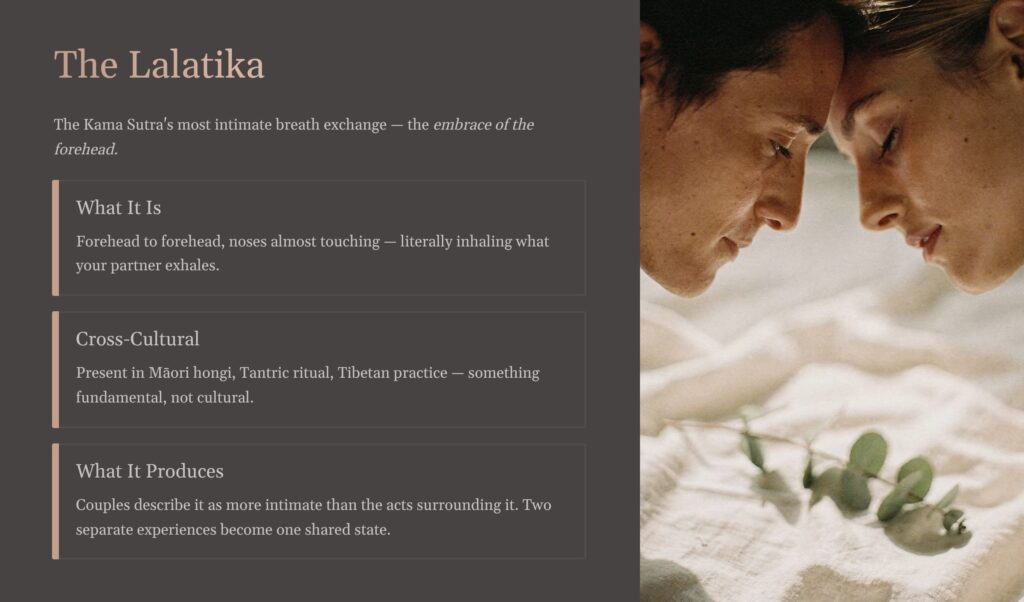
The Kama Sutra calls it the Lalatika — the “embrace of the forehead” — and describes it as follows: “When either of the lovers touches the mouth, the eyes and the forehead of the other with his or her own, it is called the Lalatika.”
In practice, this is the act of pressing your forehead to your partner’s forehead — temples touching, noses almost touching, breathing the same air. At this proximity, you are literally inhaling what your partner is exhaling, and vice versa. You are sharing breath in the most direct possible sense.
This practice appears in various forms across multiple ancient traditions — it is present in Māori greeting culture (the hongi), in certain Tantric rituals, and in Tibetan intimacy practices — which suggests it captures something fundamental about proximity and connection that transcends any single cultural context.
What it produces in practice is a particular quality of closeness that is distinct from physical closeness alone. When two people share breath at forehead-to-forehead proximity, with eyes closed, something quietens. The sense of being two separate people managing their separate experiences gives way, at least briefly, to something more like a shared state. Couples who practise this regularly describe it as one of the most intimate things they do together — more intimate, in many cases, than the acts that surround it.
You can practise the Lalatika in isolation — sitting facing each other before any other intimacy begins — or within lovemaking itself, during a moment of stillness or when you want to deepen the connection between you. The instruction is simply: bring your forehead to your partner’s, close your eyes, and breathe together for as long as feels natural.
A Complete Breathing Session for Couples: The 15-Minute Practice
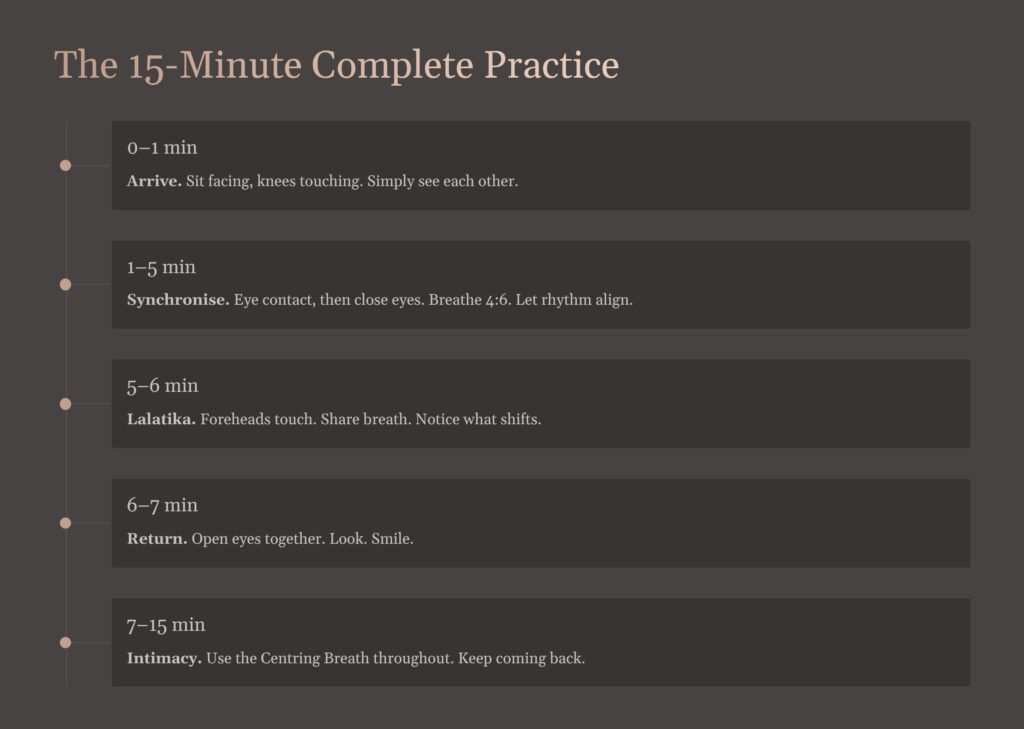
Here is a structured sequence that draws all three practices together into a single session. Use this as an entry point — a complete standalone practice you can return to any time the two of you need to find each other again.
Minutes 0–1: Arrive. Sit facing each other, knees touching. No phones. No ambient noise unless you’ve put on music specifically for this. Take a moment to simply look at each other — not searching for something, not evaluating, just seeing the person in front of you.
Minutes 1–5: Synchronise (Practice 1). Hold eye contact for one full minute — longer than is comfortable, which means you’re doing it right. Then close your eyes together. Begin breathing slowly: four counts in, six counts out. Listen for your partner’s breath. Let them fall into time with each other. Don’t force it. When you feel the synchronisation happen, stay with it for two to three more minutes.
Minutes 5–6: The Lalatika. Without opening your eyes, lean forward until your foreheads touch. Continue breathing together. Share the same air. Stay here for one minute. Notice what shifts.
Minutes 6–7: Return. Lift your heads gently, open your eyes at the same time. Look at each other. The text says to smile — and it’s right, because what usually happens at this point is that you feel something you don’t entirely have words for, and smiling is the most natural response to it.
Minutes 7–15: Move into intimacy, using the Centring Breath. Whatever follows, keep returning to your breath when you notice you’ve left. Feel it. Follow it. Come back. Every time.
FAQ: What Couples Actually Ask About Breathwork and Intimacy
Q: This sounds like meditation. I’ve tried meditation and I can’t do it. Will I be able to do this?
Probably, yes — and here’s why they’re different. Meditation practice typically involves sustaining attention on the breath alone, without any other object of focus, for an extended period. That is genuinely difficult, and for many people it produces more anxiety than calm.
What the Kama Sutra is describing is something simpler: using breath as an anchor in a context that already has plenty of sensory engagement. You’re not trying to empty your mind. You’re trying to keep coming back to the room. That’s a much more manageable task, and most couples find it accessible from the first attempt even if formal meditation has never worked for them.
Q: My partner thinks anything Tantric or breathwork-related is a bit out there. How do I introduce this without it becoming an eye-roll situation?
Don’t call it breathwork. Don’t mention Tantra. Just suggest sitting facing each other and breathing slowly together for a few minutes before things get started. Frame it as something you read about that you wanted to try. The three-minute synchronisation practice is sufficiently low-key that most sceptical partners can engage with it without feeling like they’ve been enrolled in a retreat.
The Lalatika — foreheads touching, sharing breath — is even less loaded. It’s just closeness, expressed physically. Most people respond to it regardless of their prior scepticism about anything labelled “mindfulness.”
Q: Does this work for couples who are already struggling with intimacy? Or is it only for couples who are already in a good place?
It is, if anything, more useful for couples who are struggling — specifically because it bypasses the conversational and analytical routes to connection that often feel blocked when a relationship is under stress. When two people can’t find the words, or when the words have become too loaded to use without triggering defensiveness, sitting together and breathing is a non-verbal route to the same destination.
Several couples I’ve worked with have described the synchronisation practice as the first moment of genuine closeness they’d experienced in months — not because of anything said or done, but because they’d simply been in the same room, breathing the same rhythm, without any agenda attached.
Q: The breath-hold technique at climax sounds interesting but slightly alarming. Is it safe?
For most healthy adults, yes. Brief breath-holding during arousal is not physiologically risky — it’s a voluntary version of something most people already do involuntarily at points of intensity during sex. The main cautions apply if you have a cardiovascular condition, high blood pressure, or a respiratory condition such as asthma. If any of these apply, speak with your GP before experimenting with breath-holding techniques. For everyone else, the technique is safe and the duration is short enough — five to ten seconds — that the physiological effects are well within normal tolerance.
Q: What if we try the synchronisation practice and we just can’t get our breathing to sync? Is that a sign of something?
Not necessarily. Synchronisation takes longer for some couples than others, and on some nights it comes quickly and on others it takes five minutes of sitting quietly before it happens. If it’s consistently not happening — if you sit for several minutes and the breathing never finds a shared rhythm — it may simply mean one or both partners is more anxious or preoccupied than usual on that night. That’s useful information in itself. Sometimes the practice reveals that one partner is carrying more than the other realises, which opens a conversation worth having.
Q: Can you do these practices without the other person — to prepare yourself before intimacy?
Yes, and it’s worth doing. A solo version of the centring breath — three to five minutes of slow breathing, four counts in and six out, before your partner arrives or before you approach them — is a useful way of completing your own transition from the day into the evening. It reduces the nervous system load you bring to the shared practice, which makes synchronisation easier and presence more available. Think of it as landing the plane before you try to meet someone at the gate.
What Vatsyayana Knew That We’re Still Catching Up To
There is something quietly remarkable about a 4th century Indian philosopher prescribing the exact technique — slow exhalations, synchronised rhythm, breath-holding before climax — that 21st century researchers into the autonomic nervous system would eventually explain in detail.
The Kama Sutra didn’t have the vocabulary of the vagus nerve or respiratory sinus arrhythmia. It had 1,700 years of accumulated wisdom from a culture that treated intimate life as a serious subject deserving careful study — not a taboo to be avoided or a joke to be deflected.
Its core insight about breathing is one sentence, and it is entirely correct: focusing on your breath helps you become “fully conscious of the moment.” That’s not poetry. It’s instructions.
The only question is whether you’ll try it tonight.