
Here is something worth noticing the next time you’re intimate with your partner: at some point, almost certainly, you will close your eyes.
Not because the lights are too bright. Not because you’re tired. Because something in you — habit, self-consciousness, the reflex of moving inward during an intense experience — will draw your gaze away from the person you are with.
Most of us do this automatically, without noticing, and without questioning whether it serves us.
The Kama Sutra questions it directly.
In its chapter on sight and the visual dimension of intimacy, Vatsyayana identifies sustained eye contact between lovers not as a romantic gesture but as a functional practice — one of the most powerful tools available for deepening arousal, building emotional closeness, and creating the quality of presence that distinguishes genuinely intimate sex from sex that happens to involve two people in the same room.
The text describes lovemaking as something to be witnessed as much as felt: “Feasting your eyes on your lover’s body whilst you writhe together heightens your arousal and fills your mind with sensational images.” It describes prolonged eye contact as something that “allows a lover to look deep into your innermost being and leaves you open and defenceless.”
Open and defenceless. Two words that describe both the vulnerability that deep intimacy requires, and the reason so many couples instinctively avoid it.
This article is about why that avoidance costs more than most couples realise — and exactly what to do instead.
What Happens in the Brain When You Look at Your Partner
Before getting into practice, the science behind eye contact in intimate contexts is worth understanding — because it’s considerably more interesting than most people expect.
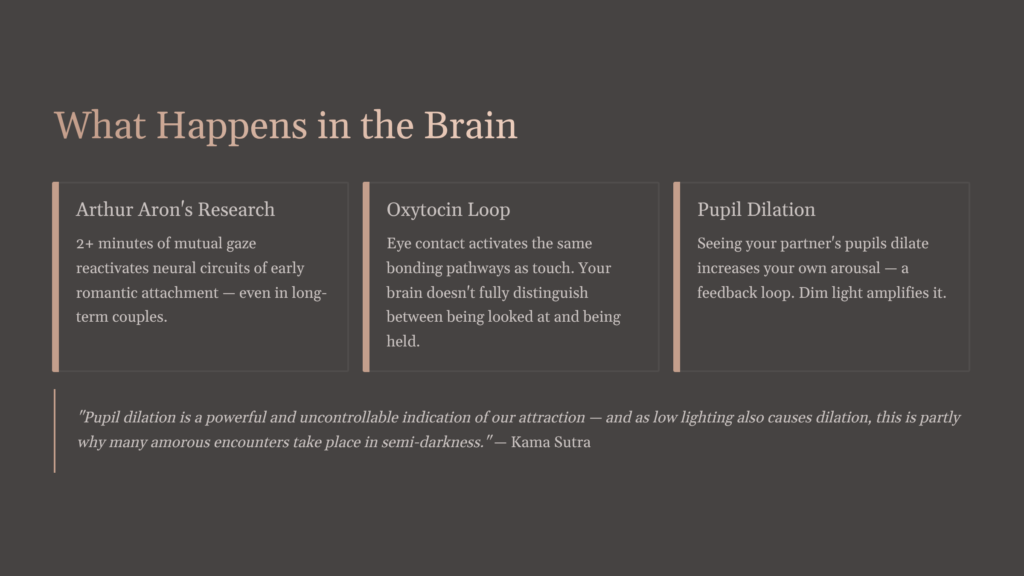
Research by psychologist Arthur Aron at Stony Brook University found that mutual, sustained eye contact between two people — holding each other’s gaze for two minutes or more — produces measurable increases in feelings of love, closeness, and passionate attraction. Importantly, this effect was found not just in new couples but in long-term partners who had been together for years. The act of looking at each other, deliberately and without breaking away, appears to reactivate neural circuits associated with early romantic attachment — circuits that in most long-term relationships have gone largely dormant through the simple mechanism of familiarity.
The physiological explanation involves oxytocin — the bonding hormone released during intimate physical contact, breastfeeding, and, it turns out, sustained mutual gaze. Eye contact activates the same oxytocin pathways as touch. Your brain does not fully distinguish between being looked at with full attention and being held. Both register as connection. Both produce the neurochemical signature of attachment.
Pupil dilation adds another layer. Your pupils dilate involuntarily when you’re attracted to someone — this is an autonomic response entirely outside your conscious control. And when you see your partner’s pupils dilate in response to looking at you, your own arousal increases in turn. It’s a feedback loop that dim lighting amplifies, which is one of the reasons the Kama Sutra consistently recommends soft, low light for intimate encounters: it makes the dilation more visible, and the response more pronounced.
The Kama Sutra identified all of this without the neuroscience. “Pupil dilation is a powerful and uncontrollable indication of our attraction,” it notes, “and as low lighting also causes dilation, this is partly why many amorous encounters take place in semi-darkness.”
An ancient Indian philosopher working out the neurobiology of arousal through observation alone. It’s worth sitting with that for a moment.
The Real Reason Couples Stop Looking at Each Other
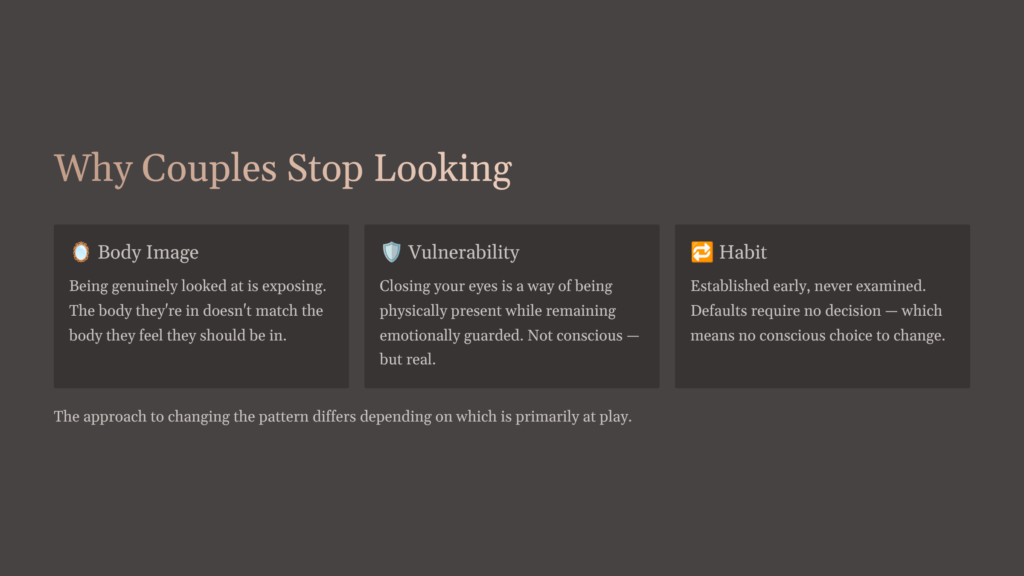
If sustained eye contact produces all of these measurable benefits, why do most long-term couples so consistently avoid it during intimacy?
The honest answer has three parts.
The first is body image. Being looked at closely — genuinely looked at, not glanced at — is exposing. For many people, particularly women navigating the physical changes of their thirties, forties, and beyond, the experience of being a subject of sustained visual attention during sex is anxiety-producing rather than pleasurable. The body they’re in doesn’t match the body they feel they should be in, and being seen highlights that gap.
The second is vulnerability. The Kama Sutra’s description of eye contact leaving you “open and defenceless” is accurate, and for many people that’s precisely what makes it uncomfortable. Eye contact in intimate contexts strips away the small protections we maintain even with our closest partners — the slight removal, the private interiority, the ability to be in the same space without being fully known. Closing your eyes is a way of being physically present while remaining emotionally guarded. It’s not conscious. But it’s real.
The third is habit. For most couples, particularly those in long-term relationships, the habit of closing eyes during sex was established early and has never been examined. It simply became the default. And defaults are powerful precisely because they require no decision — which means they also require no conscious choice to change.
All three of these are worth knowing, because the approach to changing the pattern is different depending on which one is primarily at play.
The Kama Sutra’s Visual Intimacy Practices: A Complete Guide
Practice 1: The Gaze — Before Anything Else Begins
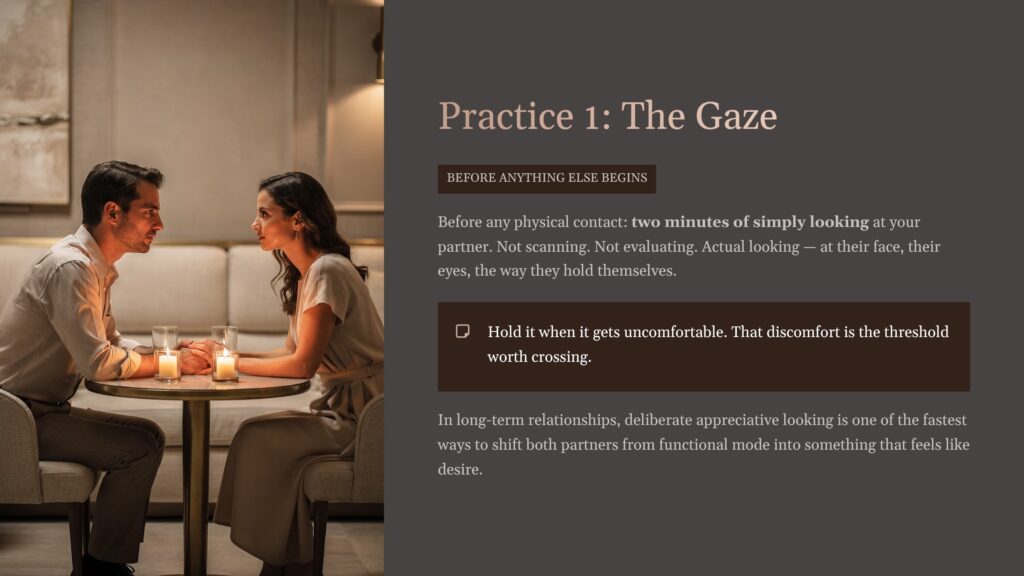
The most direct instruction in the text is also the simplest: look at your partner before physical intimacy begins, and look with full attention rather than the glancing, task-oriented seeing of ordinary life.
The Kama Sutra describes the early signs of attraction as visual ones — noting how the eyes widen slightly, how the gaze lingers a moment longer than usual, how the look that carries intention is qualitatively different from the look that doesn’t. In a long-term relationship, these signals often disappear from the repertoire entirely, replaced by a kind of visual familiarity that registers the presence of a partner without actually seeing them.
The practice: Before any physical contact begins, take two minutes to simply look at your partner. Not scanning for something, not evaluating, not the quick glance of confirmation. Actual looking — at their face, their eyes, the way they hold themselves. Let them look back at you. Hold it when it gets uncomfortable, because it will get uncomfortable, and that discomfort is the threshold worth crossing.
The Kama Sutra describes a lover who “lets their eyes roam across the body of their lover and linger” as someone giving powerful signals about their intentions. In a relationship of any significant duration, this quality of deliberate, appreciative looking is one of the fastest ways to shift both partners from the functional mode of ordinary life into something that feels like desire.
Practice 2: The 90-Second Hold — Rebuilding the Attachment Circuit
This practice draws directly from both the Kama Sutra’s instruction on prolonged eye contact and from contemporary research on mutual gaze in long-term relationships.
The instruction: Sit or lie facing each other. Hold eye contact for a minimum of 90 seconds without looking away. No speaking, no touch, no other task. Just looking.
Ninety seconds is longer than it sounds. Most couples find the first thirty seconds manageable, the second thirty seconds genuinely uncomfortable, and the final thirty seconds something they don’t quite have words for afterwards. The discomfort is not a signal that something is wrong. It is the sensation of a habitual defence being temporarily suspended — and what tends to arrive on the other side of it is the feeling of being seen by someone who has known you for years in a way that suddenly feels new.
Why this works physiologically: Sustained mutual gaze triggers the release of oxytocin within approximately 90 seconds of initiation. It also activates the brain’s mirror neuron system — the network responsible for emotional resonance and empathy — which is why after two minutes of eye contact with someone you love, their emotional state and yours begin to converge. You don’t just see each other. You begin to feel each other from the inside.
Practical notes:
If 90 seconds feels impossible to start, begin with 30 seconds and build over several sessions. The goal is to extend the duration gradually until the discomfort becomes familiar enough to stay with.
Soft, warm lighting makes this significantly more comfortable than full overhead brightness. Candlelight is not merely atmospheric — it also creates the pupil dilation that makes the gaze itself feel more charged.
Do not fill the silence with conversation. The practice is specifically non-verbal. Talking is a way of managing the discomfort of being seen; the point is to stay with the discomfort rather than narrate your way out of it.
Practice 3: Eyes Open During Sex — The Practice That Changes Everything
This is the most challenging of the three practices, and also the most transformative.
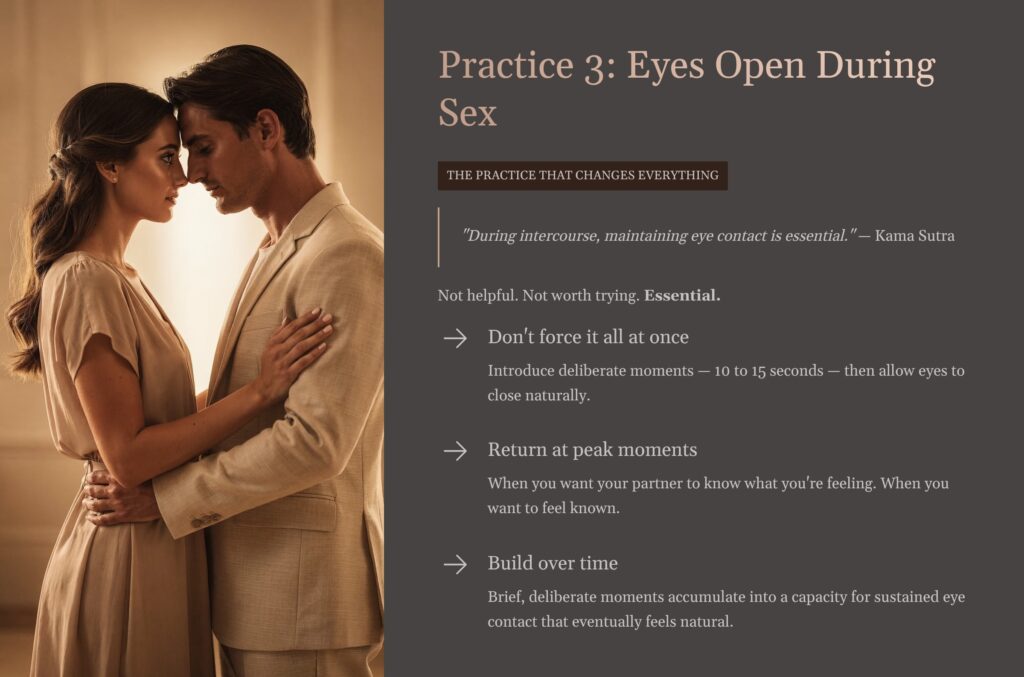
The Kama Sutra is unambiguous: “During intercourse, maintaining eye contact is essential.” Not helpful. Not worth trying. Essential. The text treats eyes-open lovemaking as the standard, not the exception.
For most contemporary couples this requires active work, because the habit of closing eyes during sex is deeply ingrained and linked to a genuine function: closing your eyes helps you concentrate on physical sensation by removing visual distraction. This is why it feels natural. But it comes at a cost. When your eyes are closed, your partner is not in the room with you in any meaningful sense. You are having a private experience that happens to be occurring alongside another person. Which is fine, but it is not intimacy in the full sense the Kama Sutra is describing.
The approach: Don’t try to keep your eyes open for an entire encounter from the first attempt. That will feel performative and self-conscious and is unlikely to produce anything except mild anxiety. Instead, introduce deliberate moments of eye contact within lovemaking:
- Open your eyes and hold your partner’s gaze for 10 to 15 seconds, then allow them to close again naturally
- Return to eye contact at moments of particular intensity — when you want your partner to know what you’re feeling, when you want to feel known
- During positions that allow face-to-face contact, orient your face toward your partner’s rather than away, and let your eyes open more than they typically do
The cumulative effect of these brief but deliberate moments of visual connection is different from sustained performance of openness. They are real — specific moments when you choose to be visible to your partner rather than retreating into your own experience. And they build, over time, into a capacity for sustained eye contact that eventually feels natural rather than effortful.
Practice 4: The Private Striptease — Being Seen on Your Own Terms
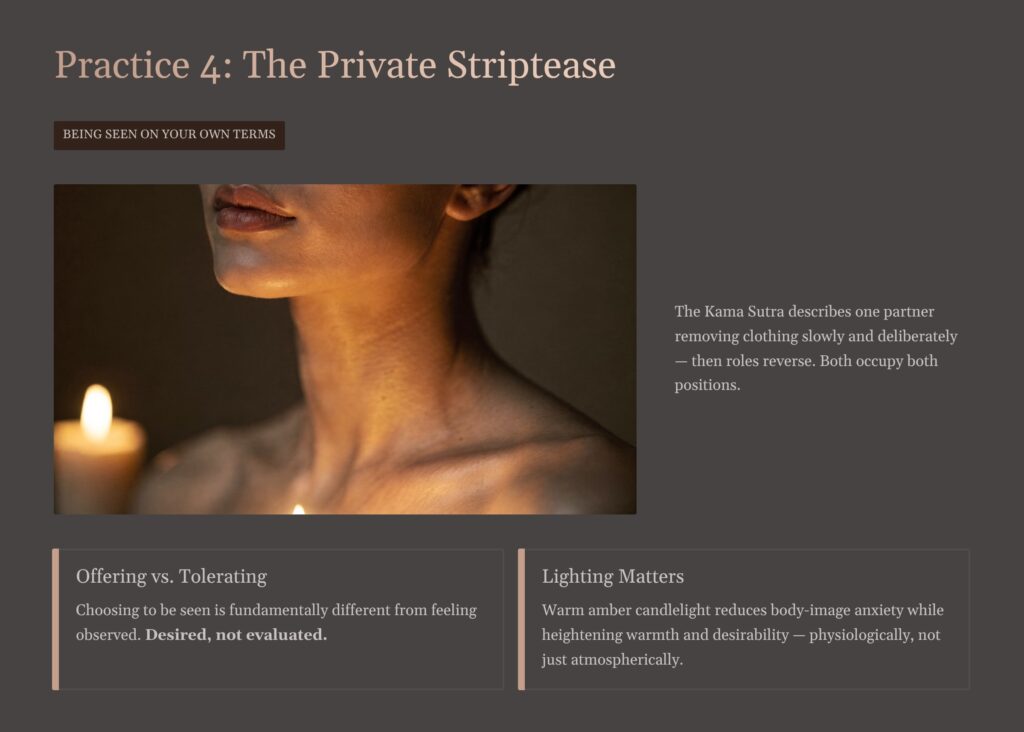
The Kama Sutra describes a practice it calls the private dance — where one partner removes their clothing slowly and deliberately for the other, initially almost imperceptibly, then more obviously once the other notices. The watching partner then becomes the performer, returning the same attention.
This practice is about sight specifically: the deliberate act of offering yourself to be seen, and receiving your partner’s full visual attention in return. Done in the right spirit — playful, unhurried, without the pressure of performance — it addresses the body image dimension of visual intimacy in a way that direct instruction cannot.
When you choose to be looked at, you are in control of the experience rather than subject to it. You are the one deciding to offer your body to your partner’s gaze, which is a fundamentally different experience from feeling observed. This distinction — between offering visibility and tolerating scrutiny — is the difference between feeling desired and feeling evaluated.
The text is clear that this is reciprocal. One partner performs, then becomes the audience as the other does the same. This mutuality is the point: neither partner is permanently the subject and the other the observer. Both occupy both positions, which equalises the vulnerability and makes the practice connective rather than exposing.
A note on lighting for this practice: The Kama Sutra consistently recommends soft, warm, dim light for intimate encounters. For the private striptease specifically, dim candlelight is not just atmospheric — it genuinely softens the visual experience in ways that reduce body-image anxiety while heightening the sense of warmth and desirability. Warm amber light is physiologically flattering to human skin in ways that cool or bright light is not, and knowing this can reduce the self-consciousness that otherwise prevents the practice from feeling pleasurable rather than awkward.
What the Kama Sutra Says About Looking at the Whole Body
Beyond eye contact, the text emphasises the practice of genuinely looking at your partner’s body — all of it, slowly, with appreciative attention rather than the habitual glance of familiarity.
“Feasting your eyes on your lover’s body whilst you writhe together heightens your arousal and fills your mind with sensational images,” the text states. The instruction is not to maintain eye contact exclusively, but to see — to actually take in the person you are with rather than retreating into closed-eye, sensation-only experience.
This is a practice that benefits from narration. Telling your partner what you see and find beautiful — not generically (“you look great”), but specifically and in the moment (“I love looking at you right now” or “the way the light is falling on your shoulder”) — combines the visual practice with the sound dimension and produces a compound effect that neither alone generates. Your partner is seen. They know they are seen. And knowing it changes how they inhabit their own body in that moment.
Research on sexual self-esteem in long-term relationships consistently finds that feeling desired by a long-term partner — genuinely, specifically desired, not merely tolerated or routinely present — is one of the strongest predictors of sexual satisfaction and motivation across all age groups. The look that communicates desire is one of the most accessible and underused tools in any long-term relationship.
FAQ: What Couples Actually Ask About Eye Contact and Intimacy
Q: I find eye contact during sex genuinely uncomfortable. Is that unusual, and does it mean something is wrong?
It’s far more common than most people admit, and no, it doesn’t mean something is wrong. Discomfort with sustained eye contact during intimacy usually reflects one of two things: body image anxiety (the vulnerability of being seen closely), or a broader pattern of emotional guardedness that shows up in physical contexts. Neither of these is a character flaw. Both are patterns that respond to gradual, patient practice. Start with the 30-second hold in low light before any physical contact begins. Stay with the discomfort rather than avoiding it. Build from there over weeks rather than expecting transformation in a single session.
Q: My partner and I have been together for over ten years. Will eye contact exercises actually make a difference at this stage?
Yes — and arguably more so for long-term couples than for newer ones. Arthur Aron’s research on mutual gaze specifically found that the effect on feelings of love and closeness was pronounced in long-term partners, precisely because familiarity had reduced the frequency of genuinely attentive looking. What the research is showing is that the neural circuits associated with romantic attachment don’t disappear in long-term relationships — they simply go unused through the mechanism of habitual familiarity. Sustained eye contact appears to reactivate them. A ten-year relationship carries more history, more trust, and more genuine knowledge of the other person than a newer one — which means the experience of being truly seen within it can be unexpectedly powerful.
Q: I have significant body image concerns — I’ve put on weight and don’t feel comfortable being looked at. How do I work with this rather than around it?
This is one of the most honest and most common questions I receive, and it deserves a direct answer. Working with it rather than around it means acknowledging that the discomfort exists, and beginning from the minimum viable version of visibility rather than the ideal. Dim, warm candlelight genuinely changes the visual experience in ways that reduce anxiety. Face-to-face eye contact while clothed or partially clothed is a lower-exposure starting point than naked visibility during sex. And telling your partner directly — “I find it hard to be looked at right now, but I want to work on it” — is itself an act of intimate visibility that tends to produce the response you most need: being received with warmth rather than judgement. Body image concerns that significantly affect your intimate life are also worth exploring with a GP or counsellor, particularly if they’re tied to broader self-esteem patterns.
Q: What about positions where eye contact isn’t possible — rear-entry positions, for example?
The Kama Sutra acknowledges this implicitly. Not every position permits face-to-face contact, and that’s fine — different positions offer different qualities of intimacy, and the variety itself has value. The practice of eye contact doesn’t require it to be continuous or position-dependent. It requires that when face-to-face contact is available, you choose to use it rather than defaulting to closed eyes. Bring eye contact into the positions where it’s accessible, and let it do its work in those moments.
Q: My partner closes their eyes during sex and it makes me feel disconnected. How do I raise this without it becoming a criticism?
This is a communication challenge as much as an intimacy one, and it’s worth handling with care. Raising it during or immediately after sex is likely to feel like criticism regardless of the framing. Raise it instead in an ordinary, non-sexual context — during a walk, over coffee — and frame it from your own experience rather than your partner’s behaviour: “I’ve been thinking about how connected I feel when we look at each other, and I’d love to try something I read about.” Then introduce the 90-second hold as something new to try together, rather than a correction of what they’re currently doing. Most partners respond well to “I want more of this” and defensively to “you’re doing this wrong.”
Q: The striptease idea sounds terrifying. What if I just don’t have that kind of confidence?
Then start smaller. The principle of the private dance is not about performance skill — it is about choosing to offer your body to your partner’s appreciative attention rather than hiding it. That can begin with something as simple as getting undressed slowly in front of your partner, with the light on, while they watch. No choreography. No performance. Just the deliberate choice to be visible rather than to rush past the moment. Confidence in being seen tends to follow from doing it rather than precede it — which means the way to feel more comfortable being looked at is to practise being looked at, in low-stakes ways, and to let your partner’s response teach you what your own anxiety is telling you isn’t true.
The Deeper Invitation
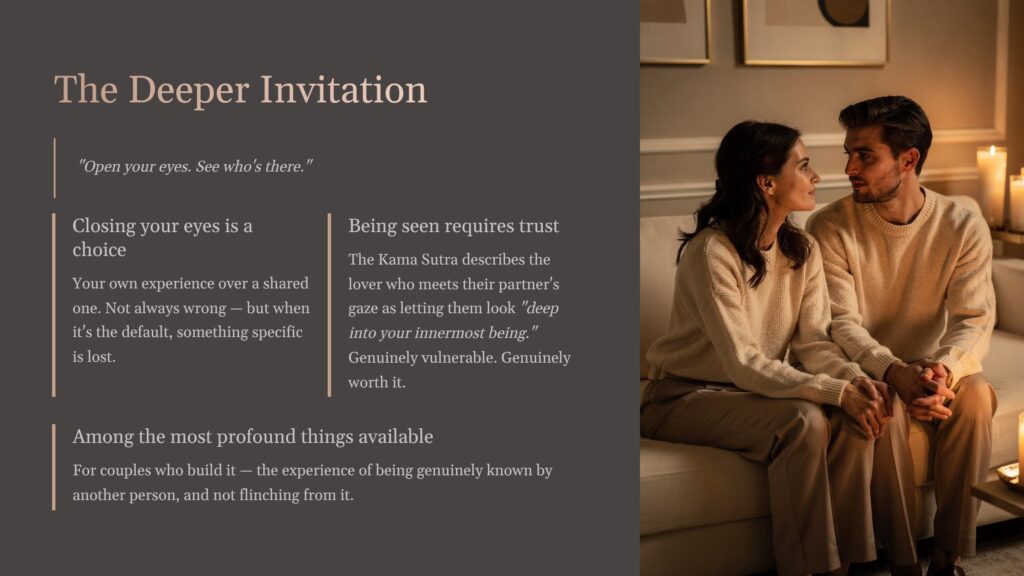
The Kama Sutra’s insistence on sight as a central dimension of intimate life is not about technique. It’s about a quality of presence that most long-term couples have gradually relinquished without noticing.
When you close your eyes during sex, you are, in some sense, choosing your own experience over a shared one. That is not always wrong — there is value in internal sensation, and not every intimate encounter needs to be a feat of mutual presence. But when it becomes the default, something specific is lost: the experience of being with someone, rather than near them. The experience of being seen and of seeing in return. The particular quality of intimacy that comes from being genuinely known by another person and not flinching from it.
The Kama Sutra describes the lover who meets their partner’s gaze as someone who lets their partner look “deep into your innermost being.” That level of visibility is genuinely vulnerable. It requires trust, practice, and a willingness to stay with discomfort that doesn’t immediately resolve.
It is also, for the couples who build it, among the most profound things available in a long-term relationship.
The practice is simple. Open your eyes. See who’s there.