
Let’s talk about missionary position.
For many couples, it’s either a trusty default or — let’s be honest — the intimate equivalent of ordering the same thing off the menu every single time. Reliable, yes. Exciting? Not always.
But here’s the thing: scientists have taken a long, hard look at this most classic of positions and come back with findings that might just change the way you approach it entirely. Not by replacing it with something exotic or requiring the flexibility of a yoga instructor — but by making a few small, anatomically brilliant adjustments that most couples have never tried.
Welcome to the Coital Alignment Technique, or CAT. It sounds like something from a university thesis (because it essentially is), but what it offers is genuinely impressive: a scientifically designed method for simultaneous stimulation of the major female pleasure zones, using nothing more than a pillow and a willingness to move differently.
Why “In and Out” Often Misses the Point
Before we get into the how, it’s worth understanding the why — because the science here is genuinely fascinating.
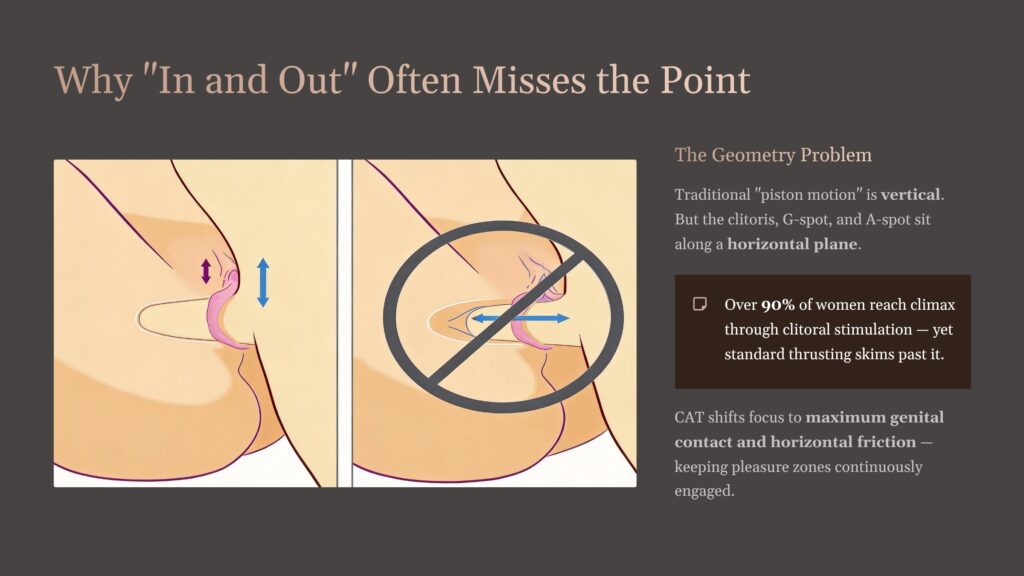
Traditional intercourse typically focuses on what researchers call the “piston motion”: a vertical, in-and-out thrusting pattern. This feels intuitive and is certainly effective for male arousal. But here’s the anatomical reality that changes everything: a woman’s primary erogenous zones are not vertically aligned — they’re horizontal.
When a woman is lying down, the clitoris (C-spot), G-spot, and A-spot all sit along a roughly horizontal plane. A purely vertical thrusting motion skims past most of this territory, particularly the clitoris, which research consistently identifies as the most reliable route to female orgasm — with over 90% of women reaching climax through clitoral stimulation.
The CAT technique essentially solves this geometric mismatch. It shifts the focus from depth and speed to maximum genital contact and horizontal friction — keeping the key pleasure zones continuously engaged rather than intermittently brushed past.
Think of it less like a piston and more like a deliberate, sustained connection.
The Setup: Small Change, Big Difference
Step 1: Start with the Pillow Trick
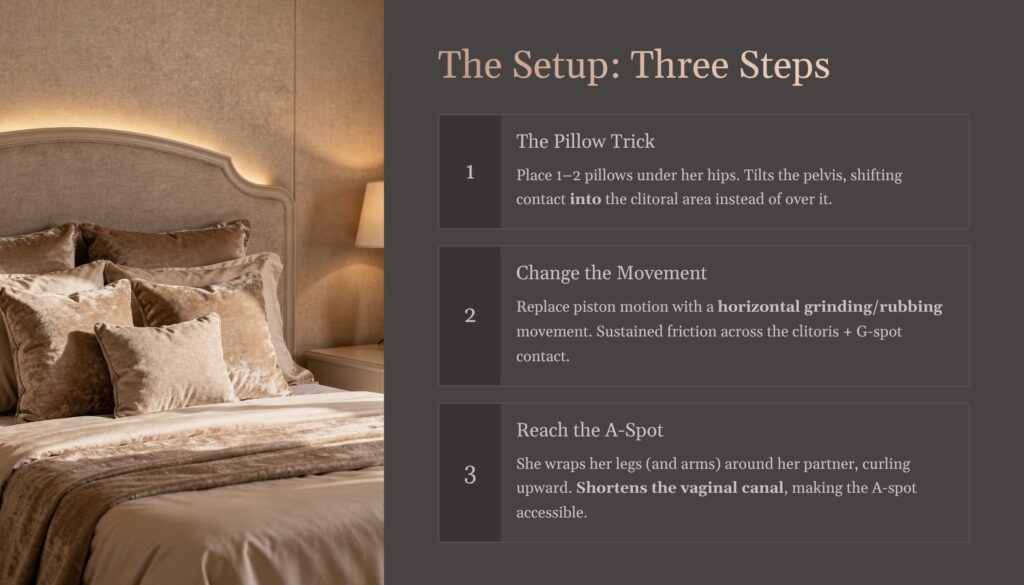
Begin in a standard missionary position, then do one thing differently: place one or two pillows under the woman’s hips.
This single adjustment — genuinely underrated in its effectiveness — tilts the pelvis upward, changing the angle of contact so that instead of movement passing over the clitoral area, it presses into it. The genitals align for horizontal movement and sustained contact rather than the passing engagement of a traditional thrust.
It’s a two-minute setup that meaningfully changes the physics of the entire encounter.
Step 2: Change the Movement Entirely
Here’s where the real shift happens. Once positioned, stop the piston motion and replace it with a horizontal rubbing or grinding movement.
The goal is to keep the genitals as closely pressed together as possible throughout, creating consistent friction across the clitoral area while simultaneously maintaining contact with the G-spot — located approximately 2 to 5 centimetres inside the vaginal opening along the front wall.
This takes a little practice to find a rhythm that works for both partners, and that’s entirely expected. Approaching it with curiosity rather than performance pressure is both more enjoyable and more productive.
Step 3: Going Deeper — Reaching the A-Spot
For couples who want to explore further, the A-spot offers what many women describe as a deeper, more wave-like orgasm than the G-spot alone.
Located approximately 10 to 11 centimetres inside the vaginal canal, near the cervix, the A-spot sits beyond what typical thrusting reliably reaches. But the CAT technique offers an elegant anatomical solution: the woman wraps her legs — and optionally her arms — around her partner, curling her body upward into closer contact.
This posture naturally shortens the vaginal canal, making the A-spot significantly more accessible without requiring anything unusual in terms of size or depth. The body essentially meets the technique halfway.
The Pro Tips That Make All the Difference
Foreplay Is Not Optional — It’s the Foundation
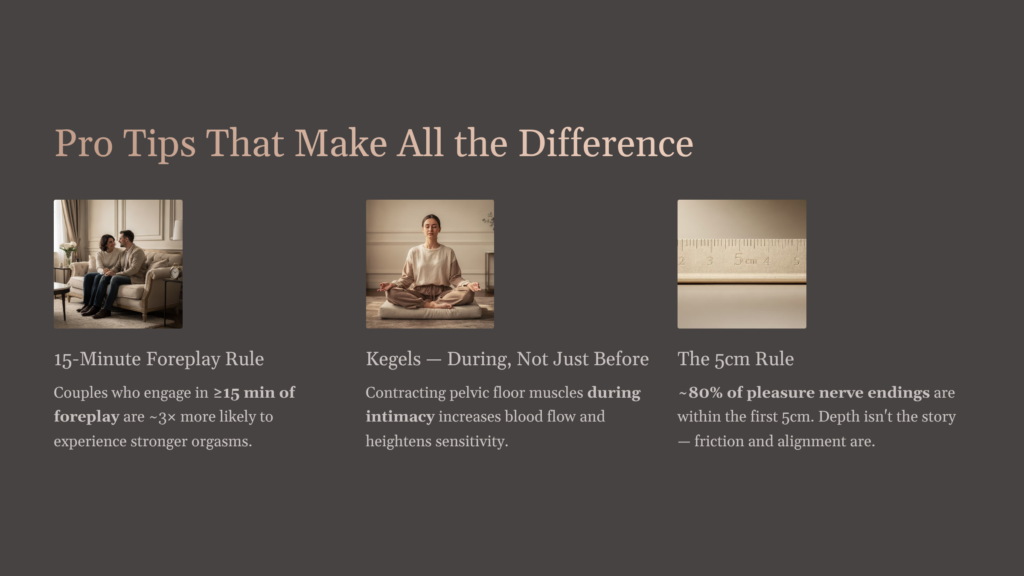
Research shows that couples who engage in at least 15 minutes of foreplay are approximately three times more likely to experience stronger and more frequent orgasms. This isn’t a suggestion to be politely noted and then skipped — it’s the data making a very clear argument for slowing down before you speed up.
For a technique that relies on sustained arousal and physical sensitivity, adequate foreplay isn’t just helpful. It’s the difference between the technique working and it falling flat.
Kegel Exercises During — Not Just Before
Most people think of Kegel exercises as something to do privately, at traffic lights or during work meetings. But consciously engaging pelvic floor muscles — contracting and releasing — during intimacy can actively increase blood flow to the area, heighten sensitivity, and intensify the experience considerably.
Think of it as turning up the volume on sensations that are already building.
The 5cm Rule — Size Really Isn’t the Story
Here’s one of the most liberating findings in this area of research, and one worth genuinely internalising: approximately 80% of a woman’s pleasure nerve endings are concentrated within the first 5 centimetres of the vaginal opening.
This is the zone the CAT technique is most brilliantly designed to engage. Depth is not the primary driver of female pleasure — friction, contact, alignment, and sustained stimulation in this highly innervated area are. The technique essentially puts its full focus exactly where the anatomy says it matters most.
Making It Work for Your Relationship
Like any shift in sexual practice, the CAT technique works best when it’s introduced with conversation rather than sprung as a surprise manoeuvre mid-encounter.
A relaxed conversation beforehand — “I read about something I’d like to try with you” — sets both partners up to approach it as a shared experiment rather than a performance. There’s no pressure to get it perfect immediately, and no reason to abandon it after a first attempt that felt slightly awkward. Most techniques of any value take a few sessions to find the rhythm that works for your specific bodies.
It’s also worth noting that the CAT technique doesn’t have to replace everything you already enjoy. Think of it as an addition to the repertoire — one that happens to be particularly well-suited to female pleasure — rather than a wholesale reinvention of your intimate life.
The Takeaway

Scientists set out to understand what actually works for female pleasure — not what looks dramatic in a film, not what’s assumed to be effective, but what the anatomy and the data support. The Coital Alignment Technique is their answer: a position and movement style designed around where the key erogenous zones actually are, how they’re actually stimulated, and what consistently produces the most satisfying outcomes for women.
A pillow. A shift in movement. A little curiosity.
Sometimes the most elegant solutions are also the simplest.
This article is intended for educational purposes and does not constitute therapeutic or medical advice. For personalised support around intimacy and sexual wellbeing, please speak with your GP or a qualified sexuality counsellor. Relationships Australia (1300 364 277) offers counselling services in every state and territory.